Showing posts with label BurdaStyle. Show all posts

Thursday, February 13, 2014

Burda 03-2012-104, Cowl Drape and Corset Drop Waist Dress

Burda 03-2012-104 Thumbnail


This rayon/mohair suiting fabric was a Fabric Mart Crazy Price $2.99/yd item that I got in September of last year.   I wasn't sure if it would be too shiny (the description was slightly alarming) but it turns out to be a very lovely rich navy with a hint of sheen, though because of the high rayon content it wrinkles fairly heavily when sitting on it.  All in all a pretty good buy (not that I ever need more fabric).

In deciding what to make with it, I was heavily influenced by this Antonio Berardi ($2065).  I love the cowl, the wide corset-style midriff, and the slightly drop waist.  I remembered that Burda 03-2012-104 had very similar lines and just had to make it.  Spoiler alert:  Mine does not capture the magic of the inspiration dress.
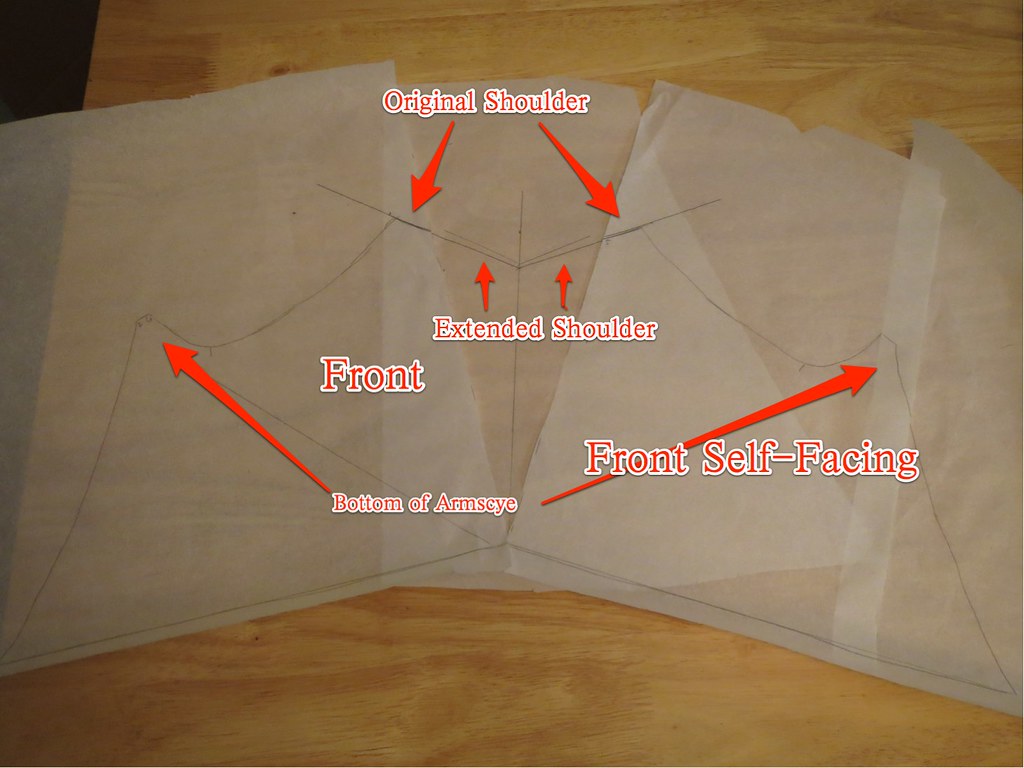
Extend Shoulder Length

The major issue with the Burda was the narrow, cut-in shoulder.  I wanted full shoulder coverage with a sleeve so I needed to extend the shoulder.  The upper cowl portion of the front is cut with a full self-facing, so it wasn't as simple as just making the shoulder longer (what I would normally do).

My method added some volume to the cowl, but based on the magazine photo it didn't look like this would make the cowl too low.

I started by making a line between the front and the front self facing long the fold line, dividing the front from the self-facing at the shoulder.  Then I split along the line and spread the pattern by the length I wanted to add to the shoulder.  I continued the angle of the shoulder line from the pattern as drafted.  The now angled center front (at the bottom of the marked-up photo) is straightened and filled in with tissue.

Completed Upper Bodice Pattern


Because the front cowl is cut on the bias, I made a complete pattern piece that could be cut single layer, integrating my alteration to the shoulder length and added volume.
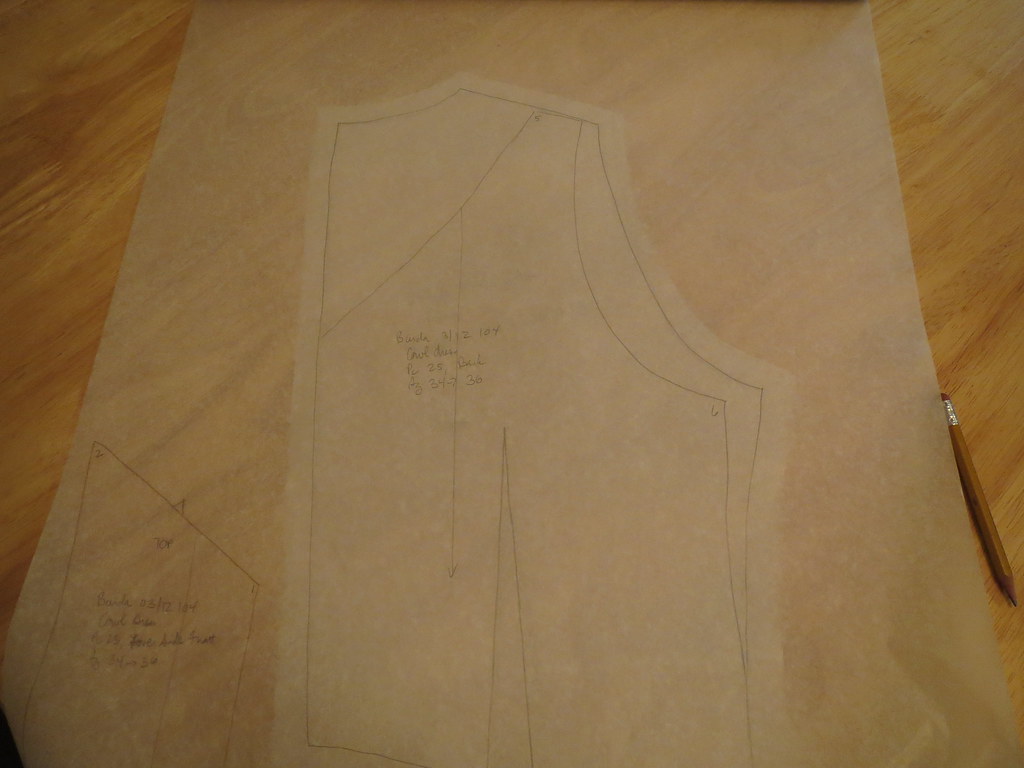
Use TNT Woven Top to Alter Back


The back was much easier to alter.  I do love having a TNT woven top.  I didn't have to do a broad back or calculate the shoulder length or anything.  I just popped my TNT under my traced pattern piece and trued it up.  Everything fits as it should in the back.
Clip to Point on Midriff


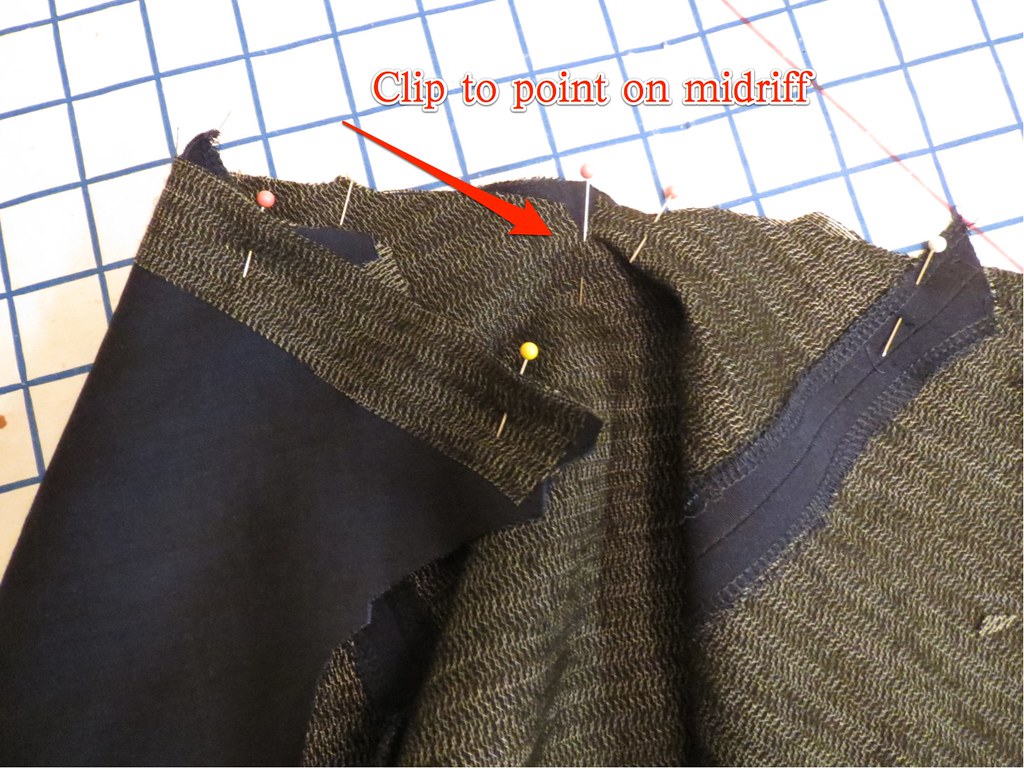
Construction was pretty straightforward.  I interfaced the front and back midriff sections because the fabric is somewhat lightweight and quite wrinkle-prone.  I wanted the corset lines to look corset-y, not collapsed and saggy.  To get the point at the front waist, I clipped all the way to the stitch line on the midriff.


Topstitching


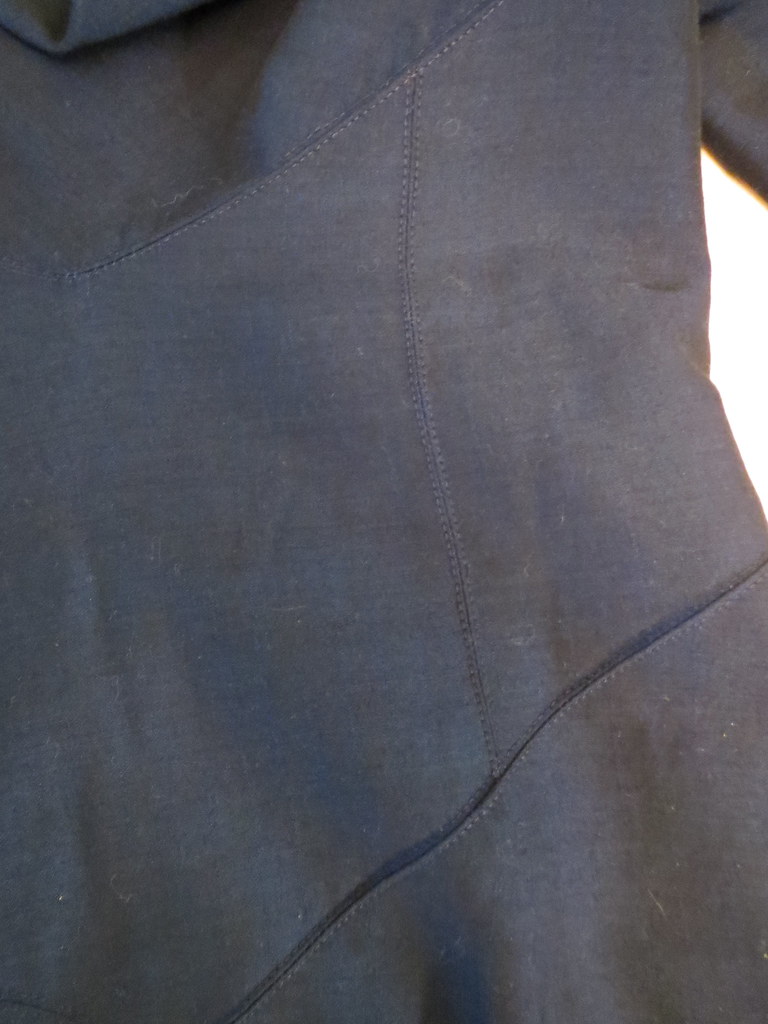
To emphasize the corset lines, I used a twin needle to topstitch along the princess seams and the joining seams with the upper bodice and the skirt.  With the dark fabric, this very subtle detail shows pretty much not at all, but I didn't want to do a contrast thread for this work dress.


Silver Lining


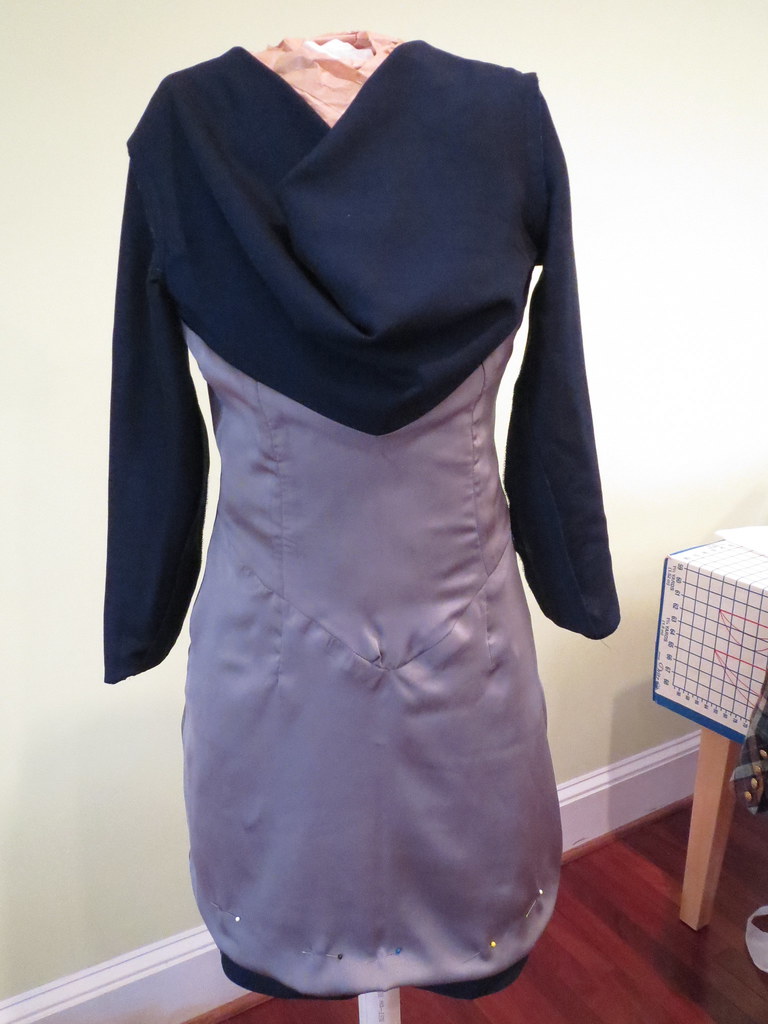
It's lined with a silvery gray poly purchased on our Pilgrimage to Fabric Mart ($1.99/yd).  The back neckline has a facing that I stitched to the lining along the lower edge of the facing before attaching at the neck, as the hand is too different between the fashion fabric and the lining to line to the edge.

I may not love the dress, but at last it has a silver lining!  (I bought 10 yards of the lining, so get used to this joke.)

Unbelted

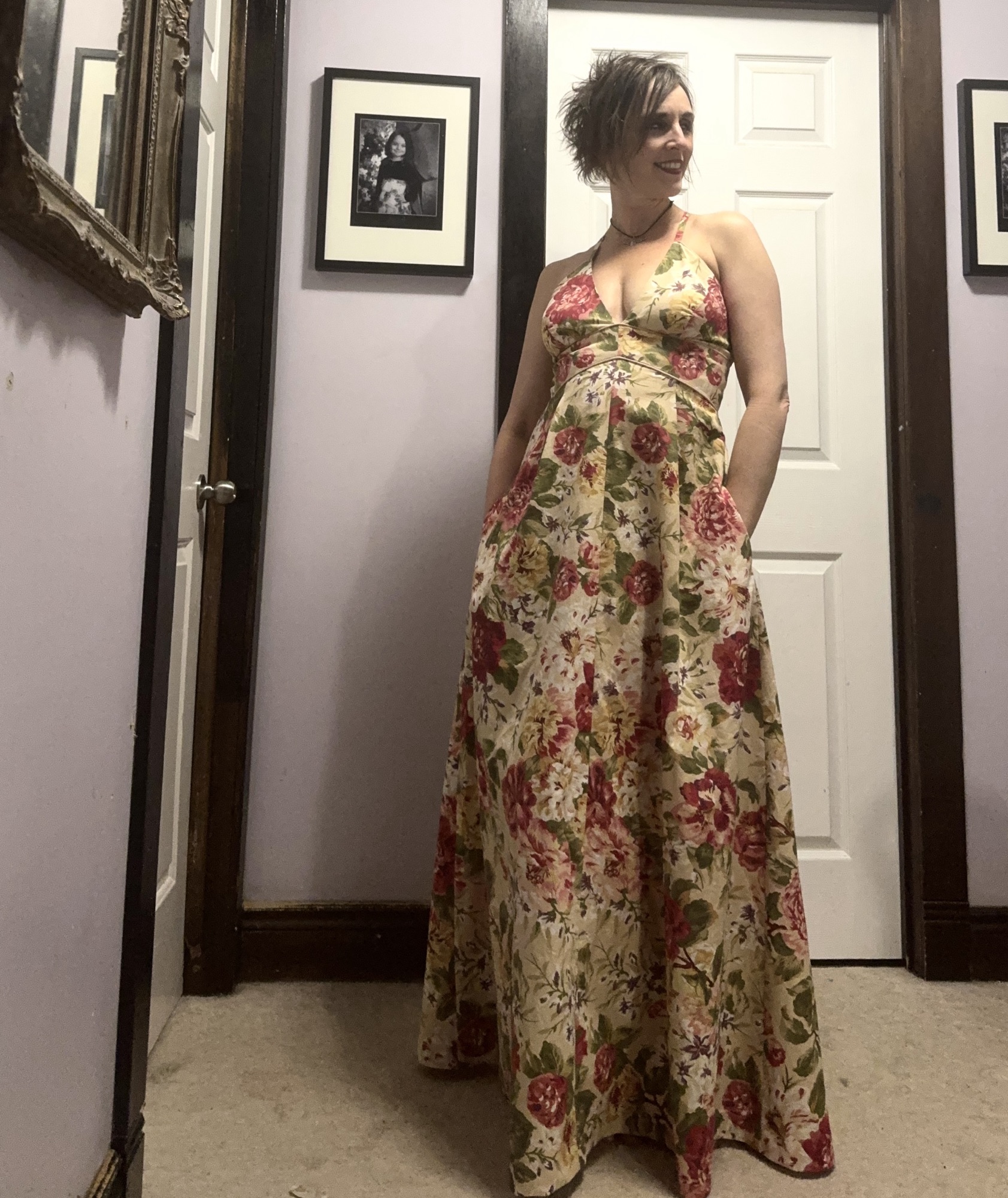
I know that I cannot wear a drop waist.  I am too short and too pear shaped for a drop waist.  Why did I think this would be different?  This is not a great dress on me.  I like the individual features of it, but the shape is not my best.

I was too influenced by the inspiration dress, and then after I finished this dress and went to look at the inspiration again, I realized that it doesn't really have a dropped waist, just a shaped one.

Front


Adding an obi helps, although then I started second-guessing myself thinking that I looked like an extra in Star Trek from a planet of peaceful peoples who put on elaborate military drills with dummy weapons as their cultural entertainment.  I don't know.  I'll keep wearing it like this but it will never be a favorite.  It does serve its purpose when I need to dress up, as it works well with a jacket.


Looking back through my woven top inspiration board, I also found this Vivienne Westwood Red Label Draped crepe top ($355) with similar lines, so maybe I can rescue the pattern by making a top from it?  Although I'm not sure if this violates my No More Empire Waist rule.

All photos are here and the pattern review is here.

Monday, July 18, 2011

Two Peas in a Pod

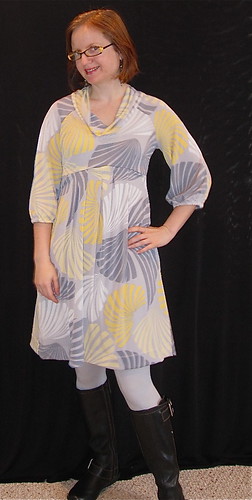
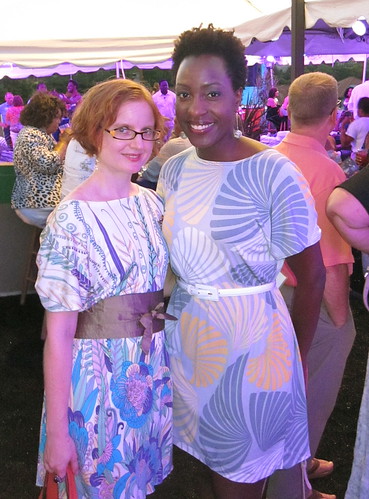
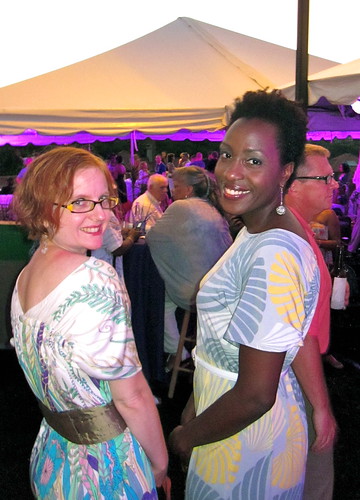
Matching Dresses Cidell invited me to be her (platonic friend) date to a party for Artscape, a wonderful Baltimore street festival for art, food, and music. I wasn't sure what to wear so I sent her a list of about a dozen dresses to choose from and she felt that my Burda 06-2010-123 silk jersey sack dress best fit the vibe of the summer cocktail party.

Side

In fact, she liked it so much for the party that she made her own! We discussed whether it would be weird to wear the same dress, but concluded that your average non-sewist would never know it was the same dress because the fabric is different. It is my guess that people would actually be more likely to think we were wearing matching dresses if we wore completely different dresses out of the same fabric than dresses from the same pattern in different fabric. Alas, I had already given my dress of the yellow and gray fan fabric (purchased together at Jomar) to the Goodwill; it never stopped feeling like a nightgown to me. So doing the real twinsie thing was not possible. This is probably a mercy.


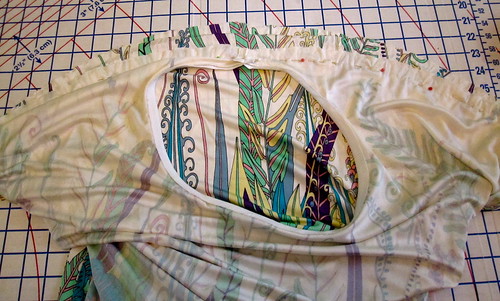
Swayback Adjustment When I finished this dress last year, I realized that it really needed a swayback adjustment. Not only do I have a fairly extreme swayback to begin with, but the weight of the elastic casing along the back shoulder pulls the dress down in back so that the front neckline comes up as high as possible. According to the line drawing, the dress is supposed to be a more balanced and hang from the shoulder rather than the front neck, but I don't know how to make that happen.

So the combination of my swayback and backward pull of the dress were resulting in major puddling over the booty. I opened out the shoulder/yoke seam and shortened the back by 2 inches at center back, as you can see on the left. It really could have used another inch and a half but that just seemed crazy so I stayed at two. it still has a little draping over the booty, but is much improved.

Matching Dresses


As predicted, nobody seemed to notice that we matched, just that we looked fabulous (heh). We spent the evening chilling on a rooftop, mingling, and watching fireworks before I headed back home on the Amtrak. I actually had not worn my silk jersey sack dress but once, because of the swayback problem. I'm glad Cidell prompted me to fix it so I can wear it for the rest of summer. I am loving the way it looks with my 06-2009-151 obi.

All the photos of this dress are here.

Tuesday, June 8, 2010

BurdaStyle Alexander Blouse

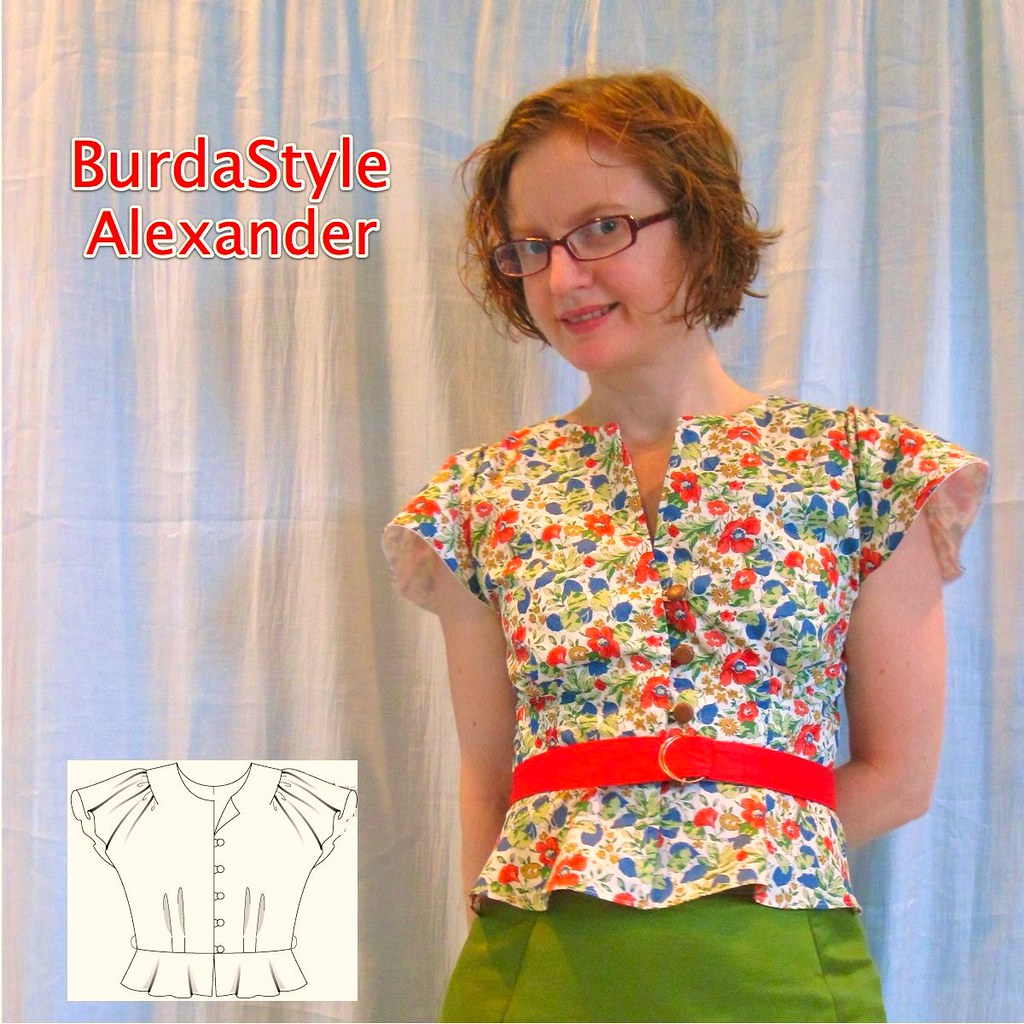
BurdaStyle Alexander Blouse #6062

Melissa first brought the BurdaStyle Alexander Blouse to my attention. I don't go to BurdaStyle very often and I rely on other people to filter the content for me. Of course, now that Burda proper no longer exists as a website, assuming they ever actually transfer the archives over to BurdaStyle I suppose I'll visit more frequently. It is SO annoying that Burda did that. Ugh.

One of the great things about BurdaStyle is that the patterns come in a large range of sizes--34 to 44 for this one. The other great thing is that anyone in the world can instantly get the pattern for about the same price. Burda is now selling magazine patterns there; they are more expensive (they all appear to be $5.40) and come in the more limited magazine range of sizes. This price per pattern seems quite high, as I pay about $6.67 per issue--only slightly more than a single pattern with no personal expenditure for ink and paper.

Join Front and Back Pattern Pieces As suggested by Melissa, I added a wedge of tissue to the sleeve where the front and back join to ensure that both were on straight of grain. I also added 5/8 inch in width to the front opening edge (or so I thought). The pattern is designed so that the front (and back, if you use the button back--I didn't, just put in a seam) edges abut each other and button with a loop and shank button. The pattern doesn't call for an underlap, but I would certainly have added one if I hadn't extended the front edge. My additional width allows the front edges to overlap so no skin shows through the front button openings, which would not be office appropriate.

Mixed Up Front and Back.  Oops. When I pinned the facing on, the front facing was mysteriously about an inch and a half too short. The cursing coming from the sewing room drew interest from my boyfriend, who had brought his computer over and was working in the other room. He came in to see what was going on and I explained that something had gone wrong with my project. He glanced over at my wall of fabric and said, very deadpan, "Oh no, and you are almost out of material." Ha ha, very funny.

I walked the pattern pieces and they matched perfectly. I was stumped. It wasn't until I was going to sleep that night that I had my A Ha moment. I had placed the front/back piece on the fabric upside down (with the writing face down) and added my 5/8 inch additional "front" button space to the back, and in sewing had treated the front as the back and vice versa. The front and back are quite similar but not identical; the front has a lower neckline and thus a shorter facing length.

To remedy, I matched the lower facing edge to the lower front edge--leaving the excess overhanging at the neck--and hand-stitched and eased the facing into place, then machine stitched and trimmed away the excess at the neck. At that point, I also shaved off about half an inch from each vertical upper edge so the neckline would open up in a pleasing way. It worked pretty well. The back neck is a little low, but I don't think it's an obvious mistake.

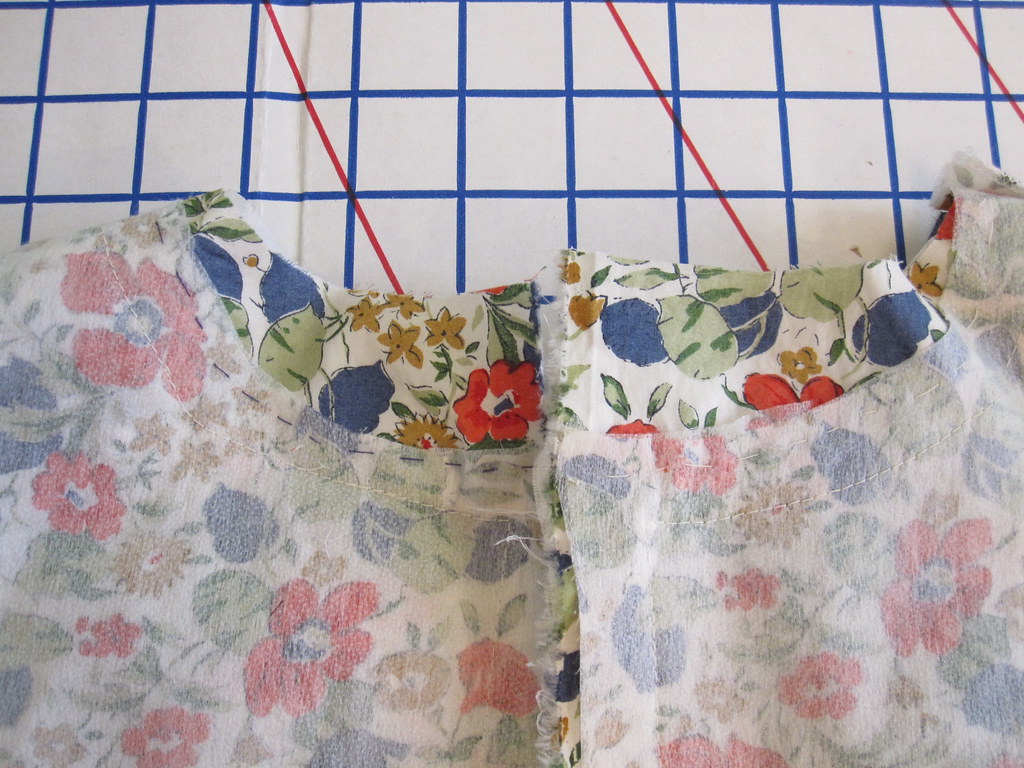
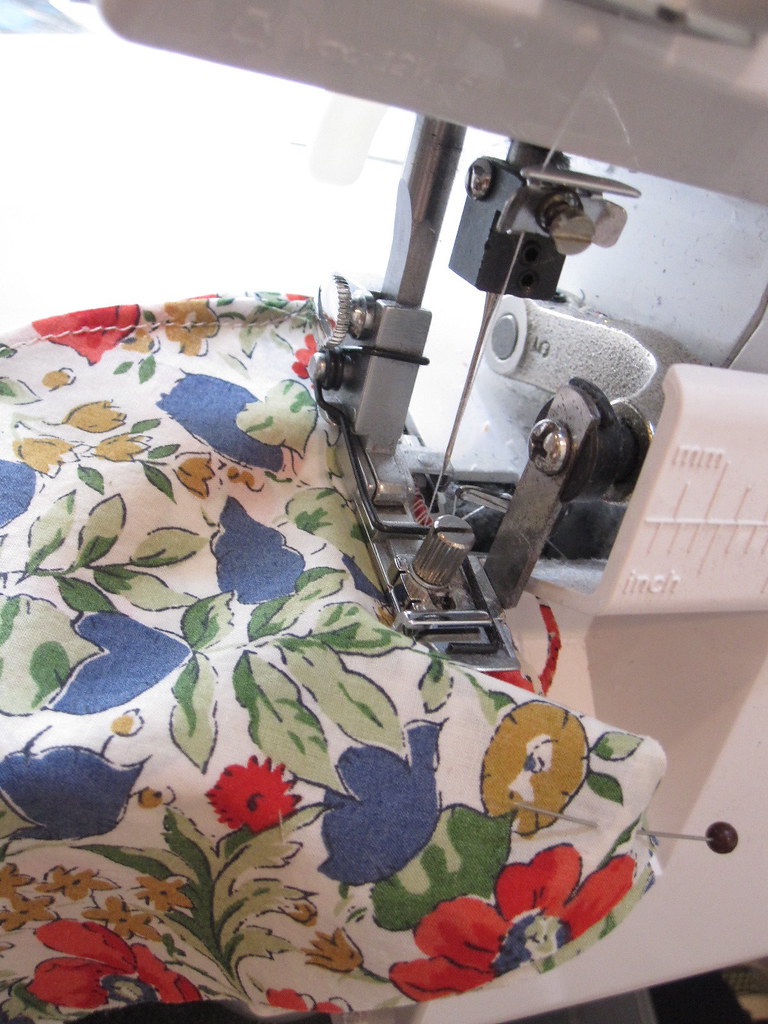
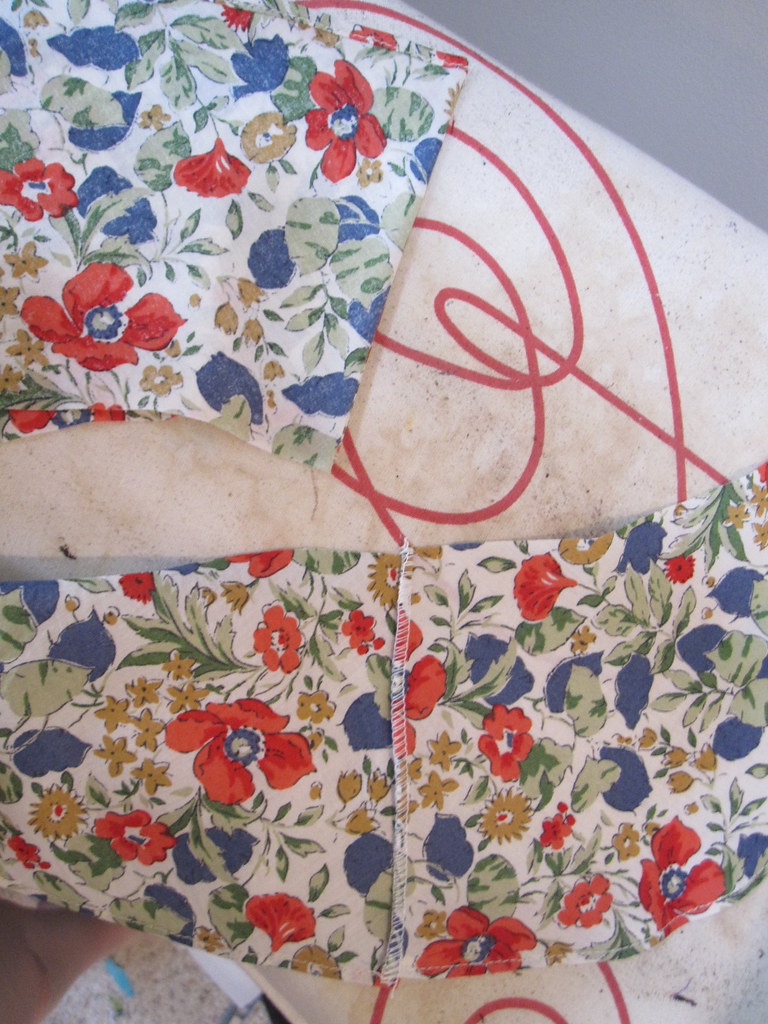
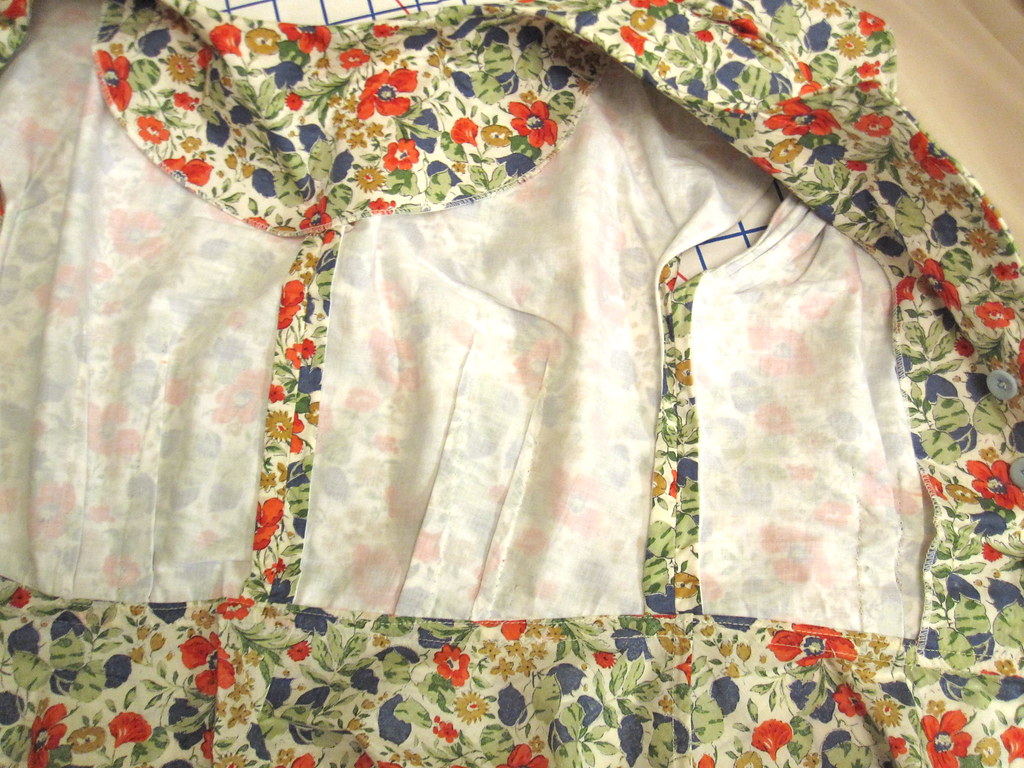
French Seam:  Use Serger for First Pass French Seam:  Press to Enclose WS Together Seam I have been on an inside finish kick lately. For the peplum, I finished the lower edges with a rolled hem. My trick for using the rolled hem foot is to zigzag the edges first to give the foot something to grab onto. I finished each lower peplum edge separately, then sewed them together with a serger French seam. First, sew wrong sides together with the serger, as shown at left. Press the serged seam to one side, then fold over and press the seam flat, right sides together. Then take the second pass with the sewing machine, enclosing your serged seam. Your lower hem will look better at the seams if you do it after making the French seam, but a rolled hem foot is too fussy to accept the bulk of a French seam so I accept a little ugliness there.

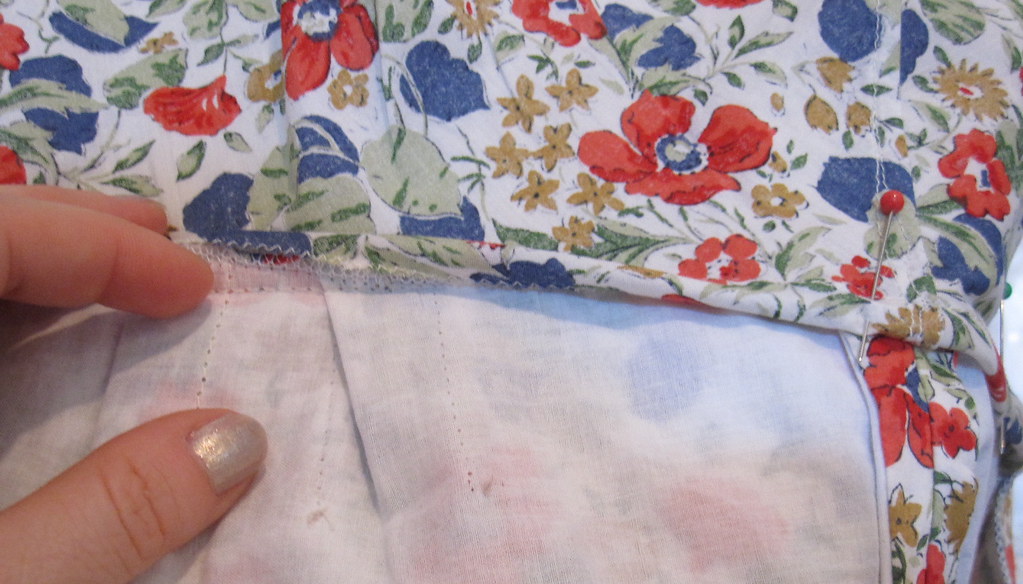
Waist Inside Finish Inside Finish Rather than do a Hong Kong Finish underlining with a wider underlining than fashion fabric to roll over the seam allowance throughout the garment, I underlined with batiste, cutting the underlining to the same size as the fashion fabric. I stitched fashion fabric and underlining right sides together for all vertical seams except center front, as that was to be faced. I had intended to hem the sleeve after finishing it with underlining, but my lovely crisp cotton lawn (purchased from Kashi) sticks out a bit rather than flowing at the sleeve edge and I didn't want to make it any stiffer. At the waist seam, I trimmed away the seam allowance of the bodice with the serger and then rolled the upper peplum seam allowance over it for a flat fell finish.

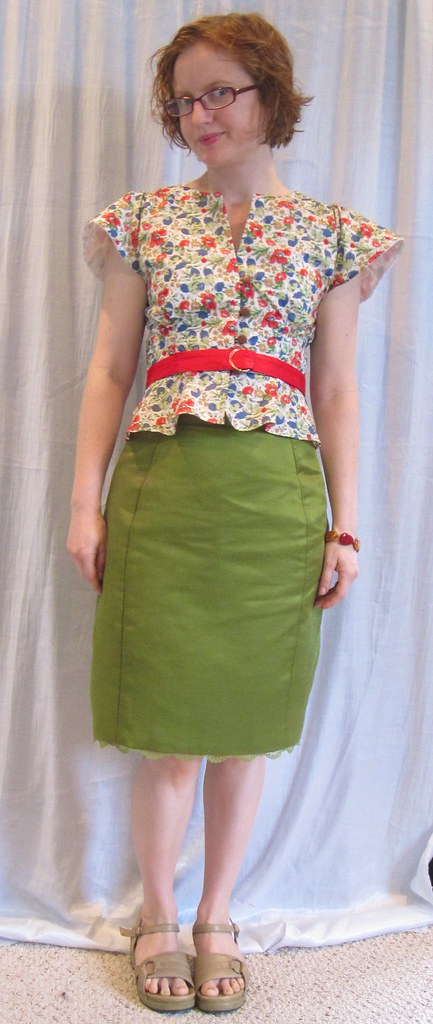
Front I normally save the list of changes for the pattern review, but since I changed this significantly I'll list them here:
-Add wedge of tissue in taping front and back pattern pieces together to preserve grain
-Add 5/8" to center front opening for over/underlap at buttons
-Shave 1/2" off the upper vertical edge of center front so the neckline falls open a bit (to see what happens when you don't, see this photo from my Vogue 8196 blouse)
-Four front buttons
-Center back seam rather than buttons
-Change back released pleats to darts (I just can't get into a puffy back)
-Underline, French seams

Would change if made again:
-Lengthen bodice a smidge
-Reduce pleat width of bodice back as there is weirdness above the darts (keep in mind that I had the front as the back but on measurement the drafted front is not significantly wider than the drafted back despite the whole bust situation)

Despite the challenges posed by this project, I totally love the final result. It has a lot of interesting design and it's flattering and fun to wear (it needs the belt, in my opinion). This is part of my "endless combinations." You can see it goes with my green skirt and it was my segue into making a red skirt (or skirts, as it turned out, when the first one didn't work out so well).

All photos are here and the pattern review is here.

Tuesday, May 11, 2010

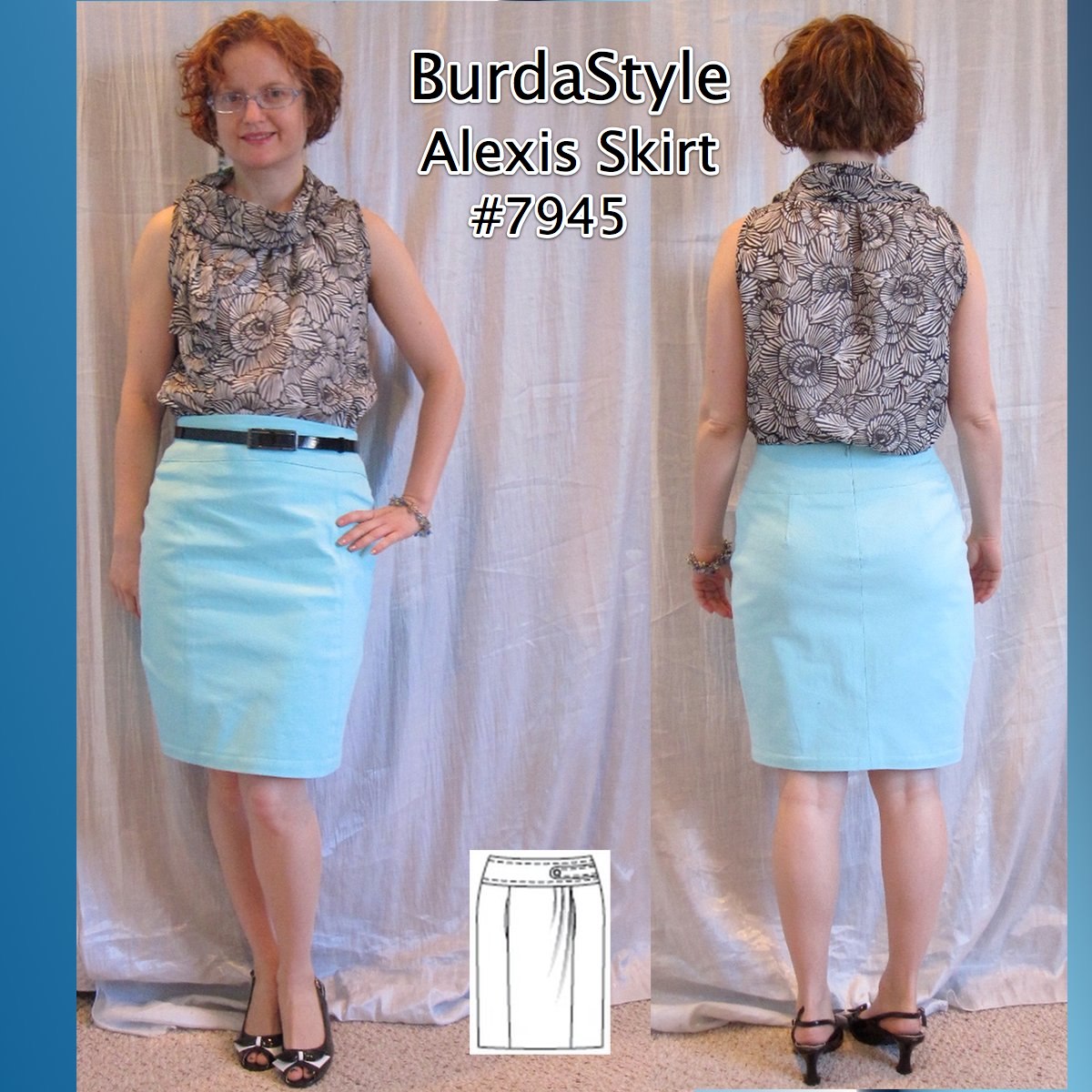
BurdaStyle Alexis Skirt, #7945

BurdaStyle Alexis Thumbnail

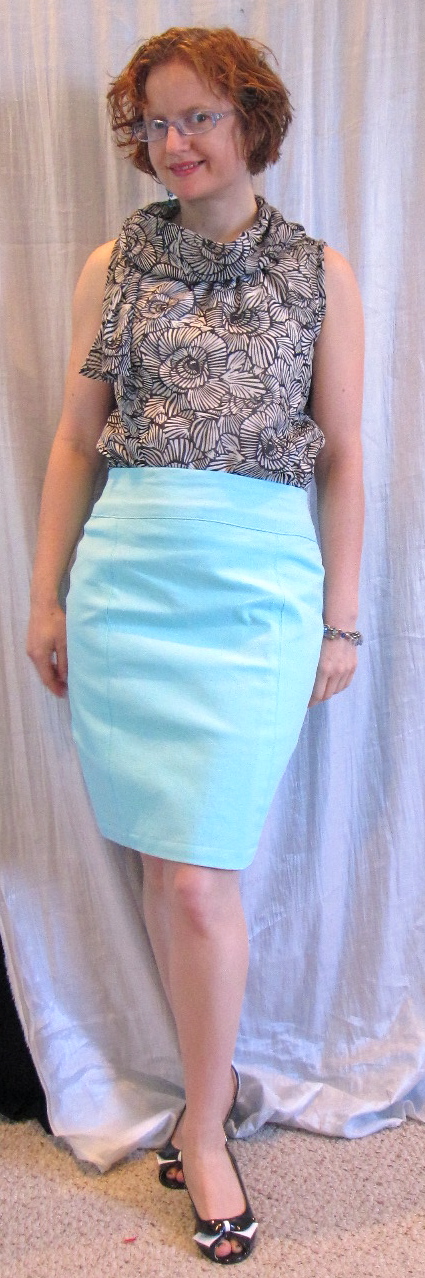
Here is another solid-colored pencil skirt for Spring, BurdaStyle Alexis. This is one of the skirt fabrics I got from Kashi when I went to NYC in March. I was *so* happy to find them as they were exactly what I was looking for--cotton twill with lycra, but unfortunately they wrinkled horribly after washing and hanging dry (I never put anything with lycra in the dryer). So I don't know how well they will actually wear. We've been having a weird cold snap and I haven't had the chance to try this skirt out yet.

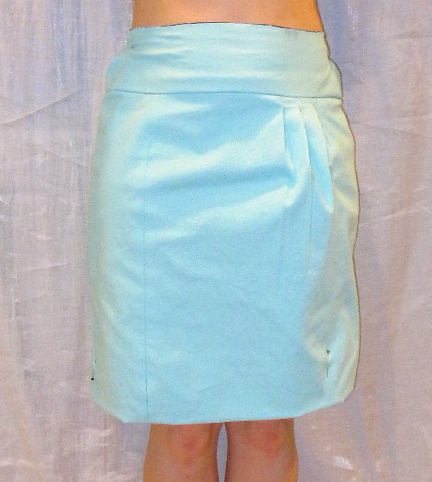
As Drafted I really like the idea of the Alexis skirt as drafted, with those asymmetric pleats in the center front panel. It is also designed with a kanagaroo pocket on the center front panel, but based on most of the photos I've seen of finished versions, the pocket seemed to make the front pop open. The last thing I want to do is add more volume to my belly! On PatternReview, elily00 left off the pocket and it appeared that this mitigated the problem with the pleats popping open. So I made it with the pleats, sewing the center front/side front seam instead of inserting a pocket. Well, yuck. The photo is really not conveying how bad the popped open pleats look, but they were awful. It looked like a had a growth on my thigh, and the pleats expanded and expanded like an accordion as I walked.

TopstitchingSince there was no chance I would ever wear the skirt as made, I decided to take out the pleats. I went back and looked at the center front panel pattern piece, and the volume for the pleats were formed by drawing a diagonal line out from the hem to the top, completely symmetrical (this may be part of the problem). I unstitched the center front panel from the side front along the pleat side and just cut out that diagonal wedge and put it back together. The center front of the CF panel is marked, so in the future I'll just put that on the fold.

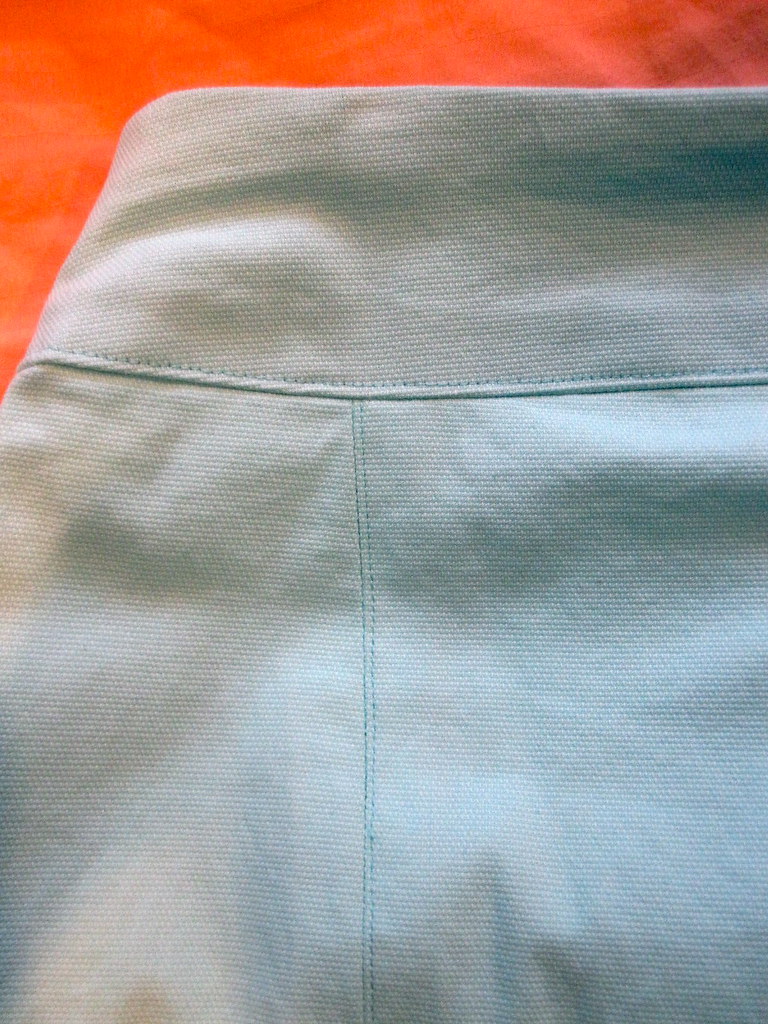
It was a straight skirt in that iteration; I pegged the side seams two inches (one inch each from front and back) to give it a pencil line. It is now a very basic skirt, but actually wearable. So I'll take basic! It has nice lines with the front princess seams and the wide contoured waistband. To emphasize those lines, I topstitched the lower waistband seam and the front princess seams in a slightly darker thread color. The effect is extremely subtle, but I think adds a nice little touch.

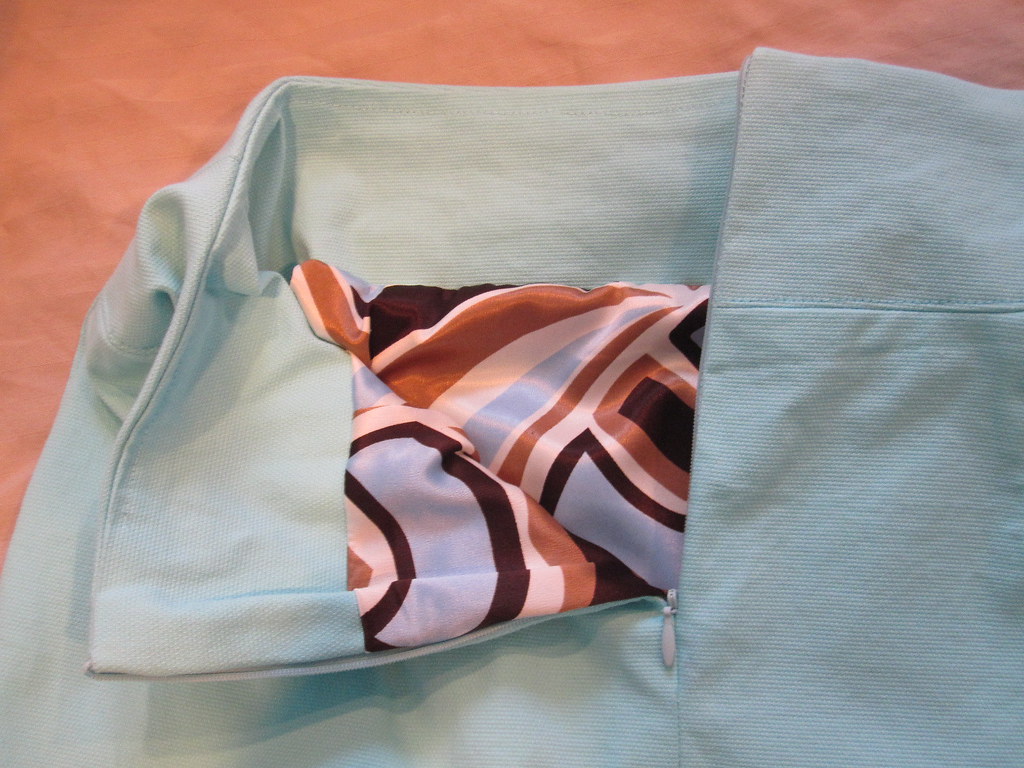
Lining Hem Finish This was the last piece of my Spring Mini Wardrobe, and I actually had the skirt done the day before the end of the contest, but my lining had not yet arrived. I ordered this stretch polyester from Fashion Fabrics Club. In the same order, I had six yards of "stretch" lining that actually had no stretch; I sent it back to FFC over two weeks ago (after corresponding with them to let them know I was dissatisfied and sending it back), with tracking and I know they got it within a few days, and have heard NOTHING from them, despite sending several emails. Has anyone ever had to get a refund from them? Any ideas?

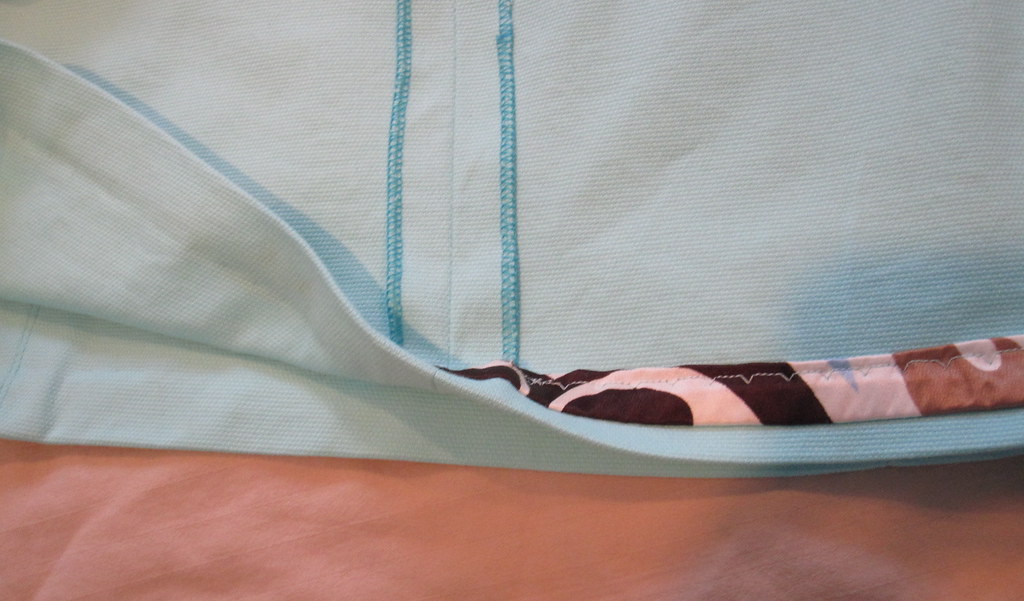
Without Belt Anyway, I like this lining. It's a fun print, very slippery, and very stretchy. I had cut off some hem length during the process of sewing this skirt, but then realized I cut off too much. Oops. I wasn't able to do a double-turned hem, so I made a hem band out of the lining fabric (along the crossgrain to have stretch) and used that to make a machine blind hem. I actually started out by doing a hand hem, but even when I took up only a thread or two of the fashion fabric my hand hem showed on the outside.

After the trials and tribulations of putting this together, I am very happy with the final result. The fabric has a bit of a pique texture, and I LOVE the color. As I said, I'm not sure how well it will hold up to wearing as it got SO wrinkled after washing, but if it is wearable I have a feeling it will be a favorite skirt for this season!

All photos are here and the pattern review is here.
Monday, March 2, 2009

BurdaStyle Kasia Skirt

Thumbnail

Despite coming of age during the Reign (or Tyranny) of Low Rise, I'm open to new things, including the high-waisted skirt. Thus, when I perused BurdaStyle (you have to register to do just about anything on the site but it's free and I've not received any spam as a result) and came upon the Kasia skirt I was totally digging it. I downloaded it back before they started charging for most pattern downloads, but Kasia is still free because it was based on a design submitted by a BurdaStyle member.

Line DrawingIt comes in a generous range of sizes (34-46) and is easy to download, print, and tape together. The taping together is a bit tedious, but the markings are clear on which pages go where. The pieces are laid out more like a Big 4 tissue than a BWOF pattern; the pieces don't overlap so it's very easy to trace out (though it would take less paper and taping time if they did overlap). The pieces themselves are well drafted, have useful markings, and go together well. I was worried about the gathered side panels drawing too much attention to my rear view, but in the end it just adds a little interest without being too blatant.

This is a popular pattern on BurdaStyle; a browse through the gallery shows it made up in a wide variety of fabrics for all different seasons. I decided to go for a transitional piece and make it in a winter white moleskin I got from Joann. I'm not sure what it is about this fabric that I love so much. It's got kind of a crushed faux suede look and is subtly metallic. I'm not majorly into suede (faux or otherwise) or metallic, and yet somehow the combination works for me in this.

Moleskin is not easy to gather or ease, so the side inset panels were a bit of a challenge. I now see why cotton is such a popular choice for this skirt. And as an aside, moleskin wrinkles like crazy! I did not expect it at all of a heavy polyester fabric, but it is pretty annoying. The light color might not have been the best choice because I feel like my stomach bulges noticeably under it (not in the photos, but after I've eaten or something), but that is mostly my self-consciousness, I think.

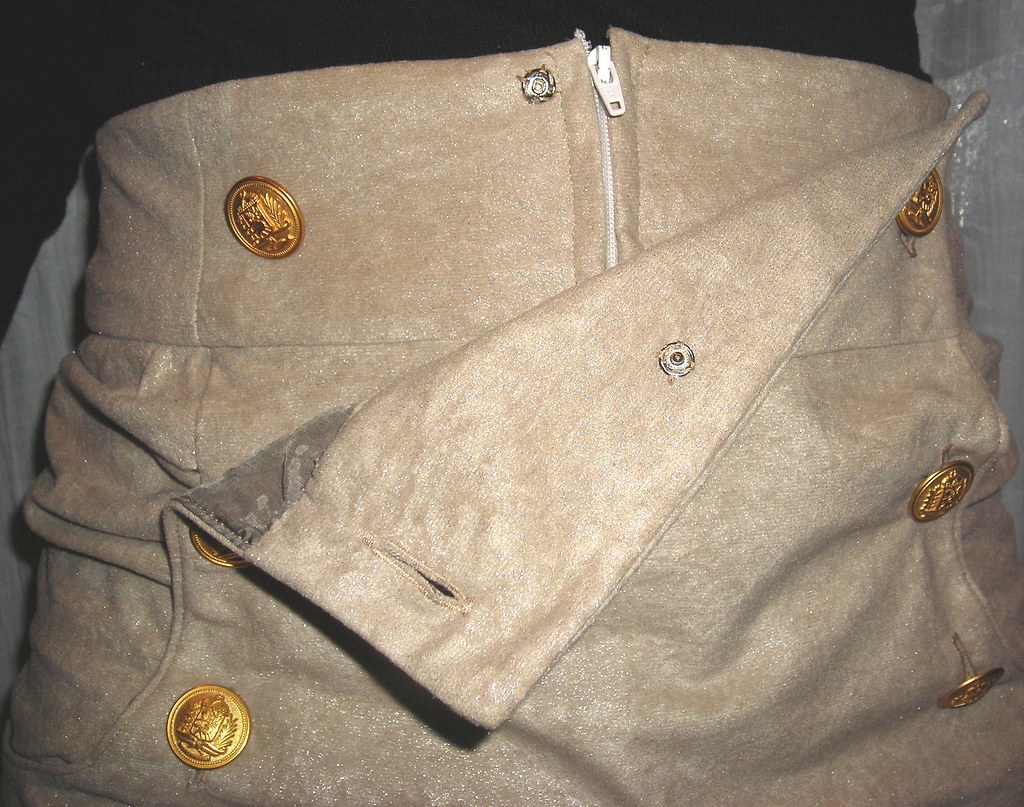
Snap The only modification I made was to add a snap to the bib to hold the outer bib over the zipper. I was having a little trouble with it sagging down and showing the top of the zipper and it just didn't look good. The snap is an easy fix. You can see the buttons in the closeup, a fun bright gold metal button with a crest from a Fabric Mart 4 pound bag of buttons.

My only complaint with the pattern is that the front bib lining goes only about halfway down the skirt. When I was planning this skirt I intended to make the inner front panel go the full length but then forgot while cutting and didn't have enough fabric to recut it. If you know it's there, you can see the ridge of the bottom of the inner panel at thigh level and it just looks a little tacky.

SideOther than that quibble I am totally loving this skirt. It looks good with a sweater *and* a Spring t-shirt. However, I'm having a little trouble styling it because I like it as a more dressy skirt, but I feel like it looks weird to have a blouse with center buttons while the skirt has side buttons. It seems like too many buttons going in too many directions. However, some of the girls in the photo gallery on BurdaStyle are wearing button blouses and they look cute. Maybe the thing is that the buttons on the shirt have to blend...which is not my modus operandi with buttons! I like them to make a statement.

All photos are here and the pattern review is here.